
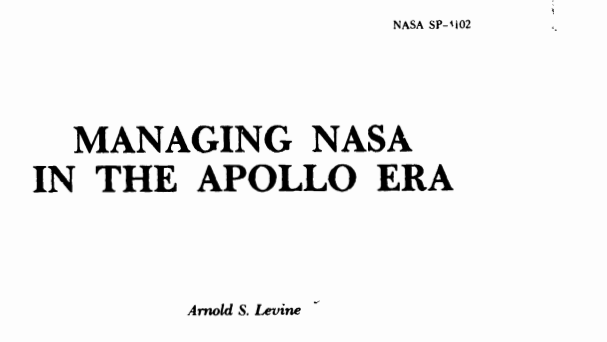
Just as hindsight offers 20/20 vision, Robert L. Rosholt’s 1983 manifesto titled “Managing NASA in the Apollo Era” provides business leaders and managers alike with a bible for mission planning during eras of breakneck speed technological advancement. These lessons are perhaps never more relevant than now with the AI tsunami peaking over the horizon.
And just as the launch of Sputnik 1 on 4 October 1957 signalled the dawn of the space age , some 65 years later on 30 November 2022, the launch of ChatGPT signalled the dawn of the AI age.
The lessons from this era from the perspective of NASA (as distilled in Rosholt’s book) show many valuable parallels between the space agency’s management challenges and those faced by modern enterprise in AI implementation .
The Parallel Challenge: Scale and Complexity
NASA’s transformation from the National Advisory Committee for Aeronautics (NACA) into a large-scale operational agency offers relevant lessons for today’s enterprises. As documented in Rosholt’s study, NASA grew from approximately 8,000 employees in 1958 to 36,000 by 1967. The agency also managed over 20,000 industrial contractors and 200 universities during the Apollo program.
Similarly, McKinsey’s 2023 “State of AI” report indicates that organizations implementing AI at scale typically need to coordinate across multiple departments including IT, data science, business units, and external vendors.
The scale up of enterprise capabilities due to the harnessing of AI presents similar challenges.
Management Innovation: Then and Now
NASA’s implementation of new management techniques, particularly the Program Evaluation and Review Technique (PPERT), revolutionized project management. According to Stephen B. Johnson’s “The Secret of Apollo: Systems Management in American and European Space Programs,” this systematic approach to planning and control became essential for managing complex technical projects.
Gartner’s 2023 research suggests that organizations need similar systematic approaches for AI implementation, recommending structured frameworks for measuring AI performance and managing development cycles.
The race to implement AI brings with it considerable dangers of expenditure on resourcing in unfruitful and unproductive ways. Business must consider careful what it’s end goals are at each phase of AI implementation.
The Resource Challenge
According to OpenAI’s 2023 analysis of large language model development, training a GPT-3 scale model can cost between $11.4 million to $27.6 million in computational resources alone. The Stanford Institute for Human-Centered Artificial Intelligence’s 2023 AI Index Report indicates that the median total compensation for AI specialists ranges from $144,000 to $264,000 annually.
Building for Success: Key Takeaways
Deloitte’s 2023 “State of AI in the Enterprise” survey of 2,620 global executives found that organizations successful in AI implementation share several characteristics with NASA’s Apollo-era management approach:
- Clear governance structures
- Systematic risk management
- Strong technical standards
- Substantial investment in human capital
Implementation Strategy
The MIT Sloan Management Review’s 2023 research on AI implementation suggests a phased approach:
Phase 1: Foundation Building
- Establish governance and ethics frameworks
- Develop technical infrastructure
- Create training programs
Phase 2: Pilot Projects
- Launch contained AI initiatives
- Gather data and feedback
- Refine processes
Phase 3: Scaled Implementation
- Expand successful pilots
- Integrate across business units
- Monitor and optimize performance
Looking Forward
According to IBM’s 2023 Global AI Adoption Index, 42% of companies are currently exploring or deploying AI, with the primary challenges being technical complexity, data complexity, and skills shortages – challenges that mirror those faced by NASA during the Apollo era.
The historical parallel between Apollo-era management and modern AI implementation provides valuable insights for business leaders. Organizations can benefit from studying NASA’s systematic approach to managing complex technical projects while adapting these lessons to modern AI challenges.
HARNIS specialises in the safe, efficient and ethical implementation and usage of AI by business.
If you’d like to reach out to discuss the implementation of AI in your business, please reach out to us at hello@harnis.ai